

When I first started working on factory entrance systems at Shenyang Manlong Metal Products Co., Ltd., most clients had a simple mindset:
a door is just a door.
But after years of installation experience in logistics centers, automotive workshops, cold storage facilities, and heavy manufacturing plants, I realized something very important:
A poorly chosen industrial door can slow down production efficiency more than a weak machine in the production line.
That is why today I want to focus on a practical comparison between the Vortex Hard Fast Door and traditional industrial doors.
Many customers ask me:
Is the Vortex system really worth the upgrade?
Can it replace standard rolling or sectional doors?
Where does it actually perform better?
In this article, I will answer these questions based on real engineering cases, not theory.
Understanding the Two Systems
A Vortex hard fast door is a high-speed industrial entrance system made from rigid aluminum alloy panels combined with a high-performance motor system.
Its key characteristics include:
High-speed opening and closing
Strong wind resistance
Excellent sealing performance
Rigid structural panels
Smart safety sensors
It is commonly used in:
Cold chain logistics
Automotive factories
High-end warehouses
Clean industrial environments
Traditional industrial doors usually include:
Steel rolling shutter doors
Sectional overhead doors
Sliding industrial doors
Basic manual or semi-automatic systems
They are widely used because they are:
Simple in structure
Lower initial cost
Easy to install
Widely available
However, they are not always optimized for high-frequency or high-performance environments.
Table 1: Structural Comparison Between Door Systems
| Feature | Steel Rolling Door | Sectional Door | Vortex Hard Fast Door |
|---|---|---|---|
| Door Panel | Steel sheet | Insulated panels | Aluminum alloy rigid panels |
| Opening Speed | Slow | Medium | Fast |
| Structural Strength | High | Medium | Very High |
| Wind Resistance | Medium | Medium | Very High |
| Sealing Performance | Medium | High | Very High |
Source: Internal engineering structural analysis, Shenyang Manlong technical records (2022–2025)
From my experience, the biggest structural advantage of the Vortex hard fast door is its combination of rigidity and speed.
Performance in Real Industrial Applications
Traditional doors often struggle in logistics environments because:
Forklifts operate frequently
Doors open and close continuously
Energy loss becomes significant
In contrast, the Vortex hard fast door improves:
Traffic flow speed
Temperature stability
Operational efficiency
This is where performance differences become very clear.
Traditional doors often cause:
Cold air leakage
Frost accumulation
Energy waste
The Vortex system provides:
Tight sealing
Fast cycle time
Reduced thermal loss
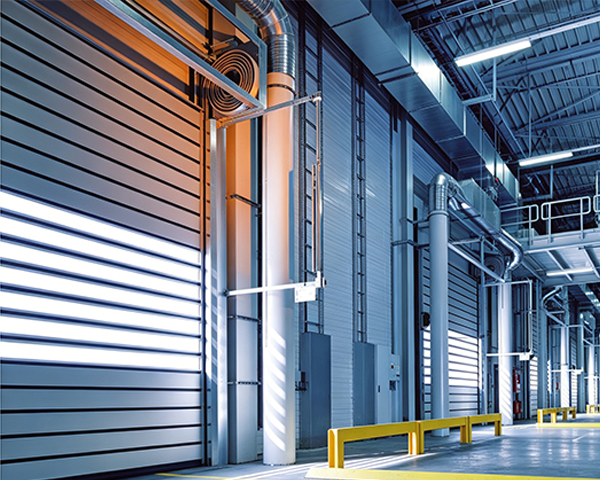
In automotive factories, precision and workflow efficiency are critical.
The Vortex hard fast door helps by:
Separating production zones
Reducing dust contamination
Maintaining stable workshop environments
Table 2: Performance Comparison in Real Scenarios
| Application Scenario | Traditional Industrial Door | Vortex Hard Fast Door |
|---|---|---|
| Logistics Warehouse | Medium efficiency | High efficiency |
| Cold Storage | High energy loss | Low energy loss |
| Manufacturing Plant | Moderate control | High environmental stability |
| High Wind Areas | Risk of deformation | Strong resistance |
| High Traffic Zones | Slower operation | Fast cycle performance |
Source: Field installation feedback from industrial projects (2023–2025)
Energy Efficiency and Operational Cost Impact
One of the most overlooked factors is energy consumption.
A door that opens 300–500 times per day directly affects:
Heating cost
Cooling cost
Air conditioning load
Traditional doors tend to:
Stay open longer
Seal less effectively
Allow air exchange
The Vortex hard fast door improves energy efficiency through:
Faster opening cycles
Better sealing design
Reduced exposure time
Over time, this difference becomes significant in operational costs.
Structural Strength and Durability Comparison
Strengths:
Reliable for basic use
Low maintenance in low-frequency environments
Weaknesses:
Susceptible to deformation under wind load
Slower operation
Limited adaptability in extreme environments
Strengths:
High-impact resistance
Wind-resistant structure
Long-term stability under high-frequency operation
Weaknesses:
Higher initial investment
Requires more precise installation
From my engineering experience, durability is where the Vortex hard fast door clearly outperforms traditional systems.
Table 3: Lifecycle Cost Comparison (5–10 Years)
| Cost Factor | Traditional Industrial Door | Vortex Hard Fast Door |
|---|---|---|
| Initial Investment | Low | Medium-High |
| Maintenance Cost | Medium | Low |
| Energy Loss Cost | High | Low |
| Downtime Risk | High | Low |
| Total Lifecycle Cost | Higher | Lower |
Source: Internal lifecycle analysis based on project maintenance data (2022–2025)
What many clients don’t realize is that the Vortex system often becomes cheaper over time.
Real Project Case Study: Automotive Factory Application
One of our projects involved an automotive assembly plant with:
High vehicle movement frequency
Strict dust control requirements
Temperature-sensitive production zones
Slow opening caused workflow delays
Air leakage affected coating processes
Frequent maintenance interruptions
After installation:
Production flow improved significantly
Environmental stability increased
Maintenance frequency dropped
This project clearly demonstrated the practical advantages of the system.
Common Mistakes When Choosing Between Door Types
A lower initial cost often leads to:
Higher maintenance costs
Energy waste
Operational inefficiency
Wind, temperature, and humidity directly affect door performance.
High-cycle environments require industrial-grade systems.
Even the best door will fail if installed incorrectly.
Practical Selection Guidelines
Based on real engineering experience, I recommend:
Usage frequency is low
Budget is limited
Environmental conditions are mild
High traffic frequency exists
Energy efficiency is important
Harsh environments are involved
Long-term cost optimization is required
Frequently Asked Questions
Not all. It is best suited for high-frequency and demanding environments.
No. Maintenance is typically lower than traditional systems when properly installed.
Yes. Opening and closing speeds are significantly higher.
Yes. It is specifically designed for high wind resistance environments.
In most industrial applications, yes—due to long-term operational savings.
Conclusion
After years of real-world engineering experience, I can confidently say that the choice between a Vortex hard fast door and traditional industrial doors is not just about product selection—it is about operational strategy.
Traditional doors still have value in low-demand environments, but for modern factories that prioritize efficiency, energy savings, and reliability, the Vortex system provides a significantly more advanced solution.
At Shenyang Manlong Metal Products Co., Ltd., we always evaluate door systems based on real operational conditions rather than theoretical specifications, ensuring each installation delivers long-term industrial value.
Shenyang Manlong Metal Products Co., Ltd.


Copyright © 2026 Shenyang Manlong Metal Products Co., Ltd. All rights reserved Applications
This website uses cookies to ensure you get the best experience on our website.

 Español
 Portugues
 Pусский
 Français
 Deutsch
 العربية
 ไทย
ไทย Türk dili
 Tiếng Việt



 Phone
Phone
Comment
(0)