Introduction: Why Choosing the Wrong industrial door Can Become an Expensive Mistake
When clients contact us about a new warehouse, manufacturing plant, logistics center, or commercial facility, they often focus on production equipment, structural steel, and automation systems. Surprisingly, one of the last topics discussed is the industrial door.
However, after years of designing, manufacturing, and installing industrial entrance systems at Shenyang Manlong Metal Products Co., Ltd., I have seen countless cases where an unsuitable industrial door caused operational inefficiencies, excessive maintenance costs, energy losses, and even safety issues.
An industrial door is not simply an opening in a wall. It is a critical part of the building's operational infrastructure. The right solution improves workflow, reduces downtime, enhances security, and contributes to long-term cost savings.
In this guide, I will compare six major industrial door systems, explain their strengths and limitations, share practical application scenarios, and introduce the engineering decision-making framework we use when helping customers select the most appropriate solution.
Understanding the Role of an Industrial Door in Modern FacilitiesBefore discussing specific products, it is important to understand why industrial doors matter.
In modern industrial buildings, doors directly influence:
Material flow efficiency
Energy consumption
Employee safety
Environmental control
Equipment protection
Building security
Operational productivity
A high-quality industrial door becomes part of the production process itself.
For example, in a logistics center operating 24 hours a day, a door may open and close more than 500 times daily. In a cold storage warehouse, every second the door remains open can affect energy consumption.
This is why selecting an industrial door requires engineering analysis rather than simple product comparison.
The Six Major Industrial Door CategoriesOver the years, our projects have mainly involved six core door systems:
1. Standard Industrial Door
A broad category that includes conventional heavy-duty industrial entrance systems used in factories and warehouses.
A high-speed flexible door designed for rapid operation and environmental separation.
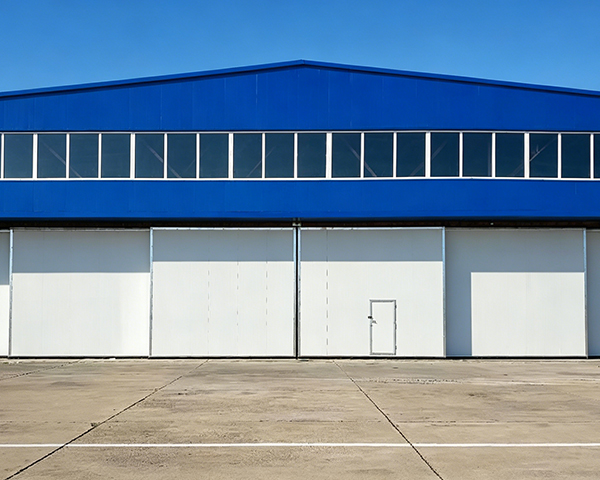
A rigid-panel high-speed door combining speed with structural strength.
A large-span solution designed for oversized openings and severe wind conditions.
A highly adaptable industrial partition and access system.
A premium residential solution focusing on aesthetics, security, and smart control.
Although each serves different applications, many customers initially struggle to determine which one best suits their project.
Table 1: Comprehensive Comparison of Six Industrial Door Systems| Door Type | Opening Speed | Wind Resistance | Security Level | Thermal Performance | Maintenance Frequency |
|---|
| Standard Industrial Door | Medium | Medium | High | Medium | Medium |
| PVC Fast Rolling Shutter Door | Very High | Medium | Medium | High | Low |
| Vortex Hard Fast Door | High | Very High | High | High | Medium |
| Rapid Stacking Door | Medium | Very High | High | Medium | Medium |
| Flexible Gate | Medium | Medium | Medium | Medium | Low |
| Villa Rolling Shutter Door | Medium | Medium | Very High | High | Low |
Source: Internal engineering performance evaluations based on installation projects completed between 2022 and 2025.
From my experience, no single door system is superior in every category. The best solution depends entirely on the operating environment.
How We Build an Industrial Door Selection SystemOne of the most common mistakes I see is selecting a door solely based on price.
Instead, we evaluate projects through five engineering dimensions.
Dimension 1: Opening Frequency
The first question I ask is:
How many times will the door operate every day?
Typical categories include:
| Daily Cycles | Application Type |
|---|
| Less than 50 | Low-frequency access |
| 50–150 | Standard industrial use |
| 150–300 | Logistics facilities |
| 300+ | High-speed operations |
The higher the cycle count, the more important motor quality and opening speed become.
For high-frequency environments, a PVC fast rolling shutter door or Vortex hard fast door often provides the best performance.
Dimension 2: Environmental Conditions
Industrial facilities vary dramatically.
Common factors include:
Temperature differences
Humidity levels
Dust concentration
Wind exposure
Chemical environments
For example:
A pharmaceutical cleanroom requires contamination control.
A coastal warehouse requires exceptional wind resistance.
A cold storage facility demands thermal sealing.
The environment heavily influences industrial door selection.
Dimension 3: Opening Size
Large openings create unique structural challenges.
A standard industrial door may perform well at moderate dimensions but struggle with oversized entrances.
For openings exceeding conventional dimensions, we often recommend:
These systems maintain stability under higher loads.
Dimension 4: Security Requirements
Different facilities require different levels of protection.
Examples include:
Medium Security
Warehouses
Distribution centers
High Security
Premium Security
In higher-security scenarios, the Vortex hard fast door often offers significant advantages.
Dimension 5: Energy Efficiency
Energy costs continue increasing worldwide.
Every opening cycle creates environmental exchange between indoor and outdoor spaces.
The most energy-efficient industrial door systems generally feature:
High-speed operation
Tight sealing
Insulated panels
Intelligent automation
These factors can significantly reduce energy losses.
Real Application ScenariosLogistics Centers
In modern logistics facilities, speed determines profitability.
Forklifts, loading vehicles, and employees constantly move between zones.
For these projects, we frequently recommend:
Benefits include:
Reduced waiting times
Improved traffic flow
Lower energy loss
Manufacturing Plants
Manufacturing facilities often require:
Safety separation
Noise reduction
Dust control
A properly selected industrial door contributes to production efficiency and workplace safety.
Cold Storage Facilities
Cold chain logistics demand precise temperature control.
Every unnecessary second of door opening increases refrigeration costs.
In these environments, high-speed insulated systems typically provide the best return on investment.
Large Warehouse Buildings
Large openings often experience:
Rapid stacking doors often outperform traditional solutions in these conditions.
Table 2: Typical Door Selection by Industry| Industry | Recommended Door Type |
|---|
| Logistics | PVC Fast Rolling Shutter Door |
| Cold Storage | Vortex Hard Fast Door |
| Manufacturing | Standard Industrial Door |
| Aircraft Hangar | Rapid Stacking Door |
| Food Processing | PVC Fast Rolling Shutter Door |
| High-End Residential | Villa Rolling Shutter Door |
Source: Internal project recommendation database and customer installation records.
The Engineering Decision Model We UseAt Shenyang Manlong Metal Products Co., Ltd., we use a simple but effective decision process.
Step 1: Analyze Traffic Flow
Questions include:
How many cycles per day?
Vehicle types?
Peak operating periods?
Step 2: Evaluate Building Conditions
Including:
Door dimensions
Structural supports
Wind exposure
Step 3: Identify Environmental Requirements
Such as:
Dust control
Temperature management
Cleanroom standards
Step 4: Assess Security Expectations
Determining whether enhanced structural protection is necessary.
Step 5: Calculate Lifecycle Costs
Rather than focusing only on purchase price.
This methodology helps avoid costly mistakes.
Table 3: Lifecycle Cost Comparison| Cost Category | Budget Door | Industrial Grade Door |
|---|
| Initial Investment | Low | Medium |
| Annual Maintenance | High | Low |
| Downtime Cost | High | Low |
| Energy Consumption | High | Low |
| Expected Service Life | 5–8 Years | 10–15 Years |
Source: Internal lifecycle cost tracking from maintenance and installation records between 2023 and 2025.
This table explains why many customers eventually choose higher-quality industrial door systems.
Common Mistakes Buyers MakeFocusing Only on Initial Cost
The cheapest solution often becomes the most expensive over time.
Ignoring Wind Conditions
Wind loads significantly affect door lifespan.
Underestimating Traffic Frequency
High-cycle environments require industrial-grade components.
Neglecting Maintenance Planning
Regular inspections dramatically reduce repair costs.
Practical Tips for Selecting an Industrial DoorBased on years of field experience, I recommend:
Start with operational requirements, not product catalogs.
Evaluate total lifecycle costs.
Consider future facility expansion.
Prioritize safety and reliability.
Work with manufacturers capable of customization.
These steps help ensure long-term success.
Frequently Asked QuestionsWhat is the most versatile industrial door?
For general industrial use, a standard industrial door remains one of the most versatile options.
Which industrial door is best for high-speed logistics?
A PVC fast rolling shutter door is often ideal for high-frequency operations.
Which industrial door handles strong winds best?
Rapid stacking doors and Vortex hard fast doors typically provide the highest wind resistance.
How long does an industrial door last?
Most industrial-grade systems provide 10–15 years of service when properly maintained.
Can industrial doors be integrated with smart control systems?
Yes. Modern systems commonly support sensors, access control, and automation platforms.
ConclusionSelecting the right industrial door is not about choosing the most expensive product or the fastest opening speed. It is about matching the door system to the actual operational demands of the facility.
Through years of manufacturing, installation, and maintenance experience, I have learned that successful projects always begin with a thorough understanding of traffic flow, environmental conditions, structural requirements, security expectations, and lifecycle costs.
At Shenyang Manlong Metal Products Co., Ltd., we approach every industrial door project as an engineering solution rather than a product sale. By combining practical field experience with customized design, we help customers create safer, more efficient, and more reliable industrial facilities for the long term.




 Español
 Portugues
 Pусский
 Français
 Deutsch
 العربية
 ไทย
ไทย Türk dili
 Tiếng Việt



 Phone
Phone
Comment
(0)